

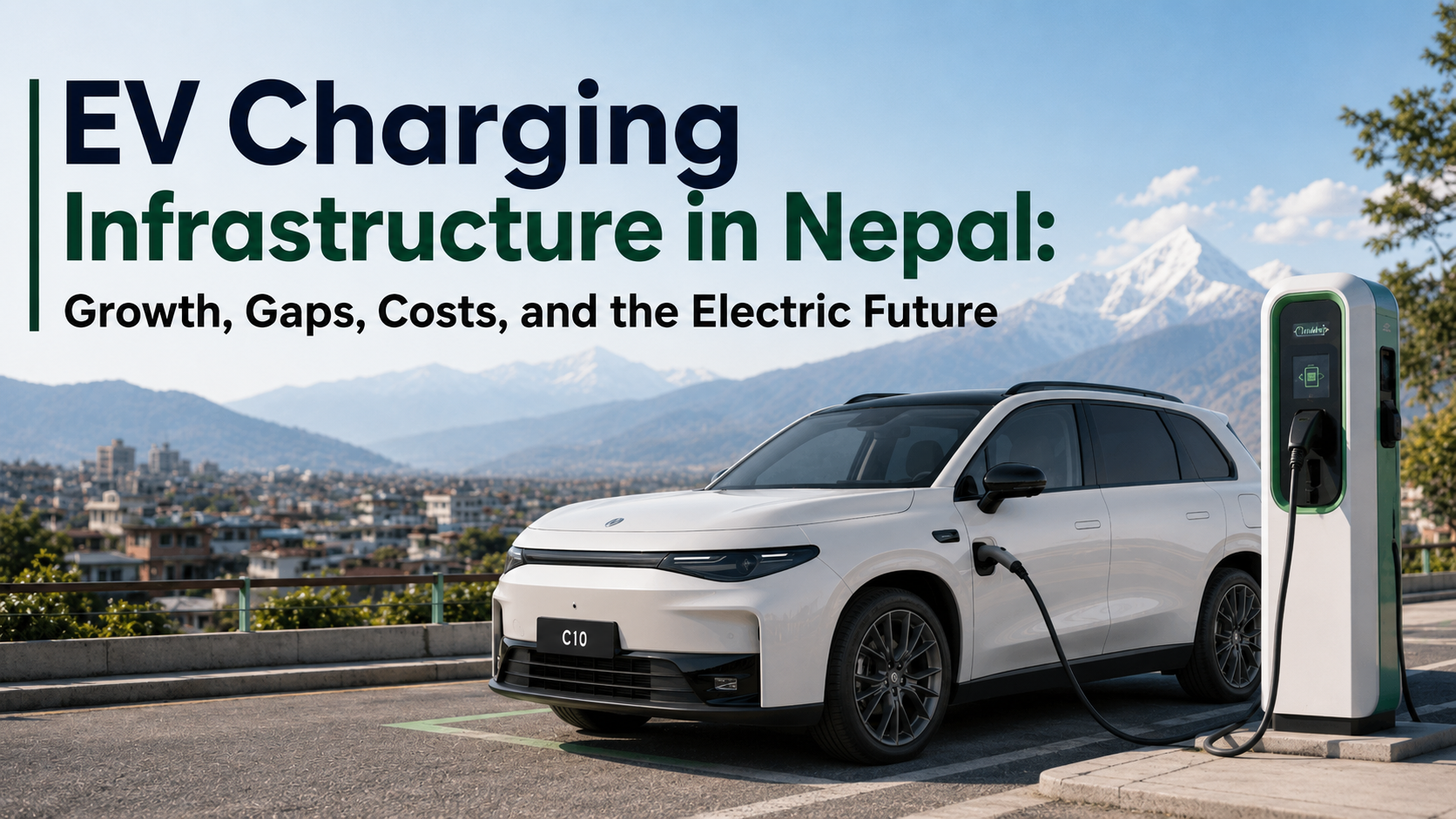
EV Charging Infrastructure in Nepal: Growth, Gaps, Costs, and the Electric Future
Electric mobility in Nepal is expanding quickly, but a key concern remains: can the current EV charging infrastructure support everyday use? Although charging station locations in Nepal are increasing and EV charging costs are becoming more affordable, many users still hesitate due to concerns around charger availability and long-distance travel reliability.
Nepal has a unique advantage. With hydropower as its primary energy source, electric vehicles are not only cleaner but also cheaper to run. This makes EV charging infrastructure a critical backbone for long-term mobility.
In this blog, you’ll get a clear understanding of how EV charging infrastructure in Nepal has evolved, where it stands today, and what challenges remain. We’ll also break down EV charging cost, explain different charger types, and explore how the charging station Nepal network is expanding across the country.
Why EV Demand Increased Fast in Nepal?
Electric vehicles have seen a sharp rise in demand since 2022. What was once a niche market has quickly become mainstream across cities and highways.
Key Reasons EV Adoption Accelerated
Rising fuel prices
Petrol and diesel costs have increased consistently. This pushed buyers to consider alternatives with lower running costs.
Government tax incentives
Nepal reduced import duties on EVs, making them more affordable compared to fuel vehicles.
Lower operating costs
EV charging cost is significantly lower than fuel expenses. This long-term saving is one of the biggest drivers of adoption.
More EV model choices
The market now offers multiple EV options from compact city cars to premium SUVs giving buyers flexibility.
Environmental awareness
Urban pollution and climate concerns are influencing purchasing decisions, especially in cities.
EV Charging Infrastructure in Nepal: Before vs Now
The transformation of EV charging infrastructure in Nepal has been rapid and visible.
| Factor | Before 2022 | 2023–2026 |
| Public Chargers | Limited (50–60 nationwide) | 1,000+ stations |
| Coverage | Mostly urban | Expanding nationwide |
| Highway Charging | Minimal | Growing corridor network |
| Fast Chargers | Rare | Common in cities |
| Travel Confidence | Low | Increasing |
The growth of EV charging infrastructure in Nepal has been fast and visible. What started as a small number of pilot stations has now become a large network supported by both public and private players.
Before 2022, Nepal had fewer than 60 public chargers nationwide. Long-distance travel in an EV required careful planning and often involved uncertainty. Charging stations were mostly concentrated in Kathmandu Valley.
From 2023 onwards, the scenario changed significantly. Nepal now has over 1,200 charging points, including government-operated stations and a large number of private installations. Fast DC chargers are now common in cities and along major highways.
Highway corridors, especially along the East–West route, are gradually becoming EV-friendly. This has made intercity travel more practical than before.
Despite this progress, the distribution of charging stations in Nepal’s infrastructure remains uneven, with rural and western regions still underserved.
Types of EV Chargers in Nepal
Nepal’s EV charging infrastructure includes a mix of AC and DC chargers, designed to meet different needs.
AC Slow Chargers
AC chargers are typically used for home or workplace charging. Most of them operate at around 7 kW, although some higher-capacity units are available.
Charging with AC takes longer, usually between 9 to 12 hours for a full charge. This makes them suitable for overnight charging or long parking durations.
They are commonly found in homes, hotels, and office spaces.
DC Fast Chargers
DC fast chargers are the backbone of public charging stations in Nepal networks. These chargers usually operate between 40 kW and 120 kW or more.
They can charge an EV from 0 to 80% in about 60 to 150 minutes, depending on the vehicle and charger capacity.
These chargers are widely installed in urban centers, highways, and commercial areas such as restaurants and dealerships.
Ultra-Fast Chargers (Emerging)
Ultra-fast chargers, with capacities above 200 kW, are still in the early stages in Nepal.
These chargers can significantly reduce charging time to around 15–30 minutes. They are expected to play a key role in future highway infrastructure and commercial EV operations.
EV Charging Cost in Nepal
Understanding EV charging cost is critical when evaluating the overall affordability of electric vehicles.
Home Charging Cost
Home charging remains the cheapest option. It is based on residential electricity tariffs, which range from approximately NPR 4 to NPR 13 per kWh depending on usage.
For most EV owners, this is the primary method of charging. It offers the lowest cost and the convenience of charging overnight.
Example:
- 30 kWh battery → ~NPR 300–400 per full charge
- Cost per km → around NPR 1.3–2
Public Charging Cost
Public charging costs are slightly higher and vary based on the operator.
- Government-operated stations typically charge around NPR 11–12 per kWh
- Private charging stations range from NPR 13 to NPR 20 per kWh
Some private operators may also use alternative pricing models, such as charging based on battery percentage or session time.
Cost Per Kilometer
Even with higher public charging rates, EV charging cost per kilometer remains significantly lower than petrol or diesel vehicles.
- Electric cars typically cost around NPR 1.5–2.5 per km
- Electric SUVs range between NPR 2–3.2 per km
This cost advantage is one of the main reasons for the rapid growth of EV adoption in Nepal.
Charging Station Nepal: Regional Coverage
The growth of the charging station Nepal network is clearly visible, but it is not evenly distributed yet. Some regions already offer reliable access to EV charging infrastructure, while others are still catching up. Understanding this gap helps set the right expectations for EV users, especially those planning long-distance travel.
Areas with Stronger Charging Access
In a few key regions, EV charging infrastructure is already well established and continues to expand steadily.
Kathmandu Valley
Kathmandu Valley has the highest concentration of charging stations in the country. Most public and private operators prioritize this area, making it the most convenient place for EV owners. Whether it’s daily commuting or quick top-ups, charging access is rarely a concern here.
Pokhara
Pokhara is quickly building a strong charging network. With rising EV adoption and tourism demand, more fast chargers are being installed, making it easier for both locals and travelers to rely on electric mobility.
Chitwan
Chitwan is becoming an important link for intercity EV travel. Charging availability here supports smoother movement between major cities, reducing dependency on a single charging hub.
East-West Highway corridors
The expansion along the East-West Highway is a major step forward. Strategic placement of charging stations is making long-distance travel more practical, allowing drivers to plan routes with greater confidence.
Areas That Need More Charging Stations
Despite progress, several regions still lack sufficient EV charging infrastructure.
Mid-western Nepal
Charging stations are limited, and coverage is not yet consistent. This makes EV usage less practical for everyday travel in this region.
Far-western Nepal
Infrastructure here is still in the early stages. Fast charging options are very limited, which affects long-distance EV adoption.
Rural hill routes
Geography plays a major role in slowing expansion. Difficult terrain and lower demand make it challenging to install and maintain charging stations in these areas.
Government vs Private Charging Networks
The development of EV charging infrastructure in Nepal is being shaped by both government initiatives and private sector investment. Each plays a different but equally important role.
Government Role
The government has focused on building the foundation for EV growth.
Core infrastructure rollout
Most of the early charging stations were installed by government bodies. This initial push helped introduce EV charging to the market.
Highway corridor support
There has been a clear focus on connecting major highways. This ensures that EV users can travel between cities without major limitations.
Affordable access
Government-operated stations usually offer lower EV charging cost, making them accessible to a wider group of users.
Private Sector Role
Private companies are accelerating the expansion of charging station Nepal networks.
Fast charging hubs
Private operators are investing in high-capacity DC fast chargers, especially in cities and along highways. These hubs reduce charging time and improve convenience.
Commercial locations
Charging stations are now commonly found in malls, hotels, restaurants, and dealerships. This makes charging part of everyday routines rather than a separate task.
Better customer convenience
Private networks often provide digital payment options, app integrations, and smoother user experiences, making charging quicker and more efficient.
Why EV Charging Infrastructure Matters for Nepal?
EV charging infrastructure is more than just a support system for vehicles. It directly impacts Nepal’s economy, environment, and energy future.
National Benefits
Lower fuel imports
Nepal depends heavily on imported fuel. Expanding EV usage reduces this dependency and keeps more money within the country.
Cleaner air
Electric vehicles produce no tailpipe emissions. This helps reduce pollution, especially in urban areas.
Lower transport costs
With lower EV charging costs compared to fuel, transportation becomes more affordable for individuals and businesses.
Better energy security
Using locally generated electricity strengthens national energy independence.
Hydropower utilization
Nepal produces most of its electricity through hydropower. EV adoption allows better use of this renewable resource.
Why Leapmotor Fits Nepal’s EV Future – Leapmotor Nepal
As Nepal’s EV charging infrastructure continues to expand, vehicle compatibility, efficiency, and real-world usability are becoming more important for buyers. This is where Leapmotor aligns well with the country’s evolving electric mobility ecosystem. The brand focuses on practical performance, efficient energy use, and technology that complements both urban and highway driving conditions.
Leapmotor vehicles are designed to work efficiently within Nepal’s current charging station network, whether users rely on home charging or public fast chargers. With a balance between battery capacity, driving range, and charging flexibility, these models help users manage EV charging costs effectively while maintaining convenience.
Models to Explore with Leapmotor Nepal
Leapmotor B10:
The B10 EV car is positioned as a balanced option for everyday driving. It offers a combination of usable range, comfortable design, and stable performance, making it suitable for both city commutes and occasional long-distance travel. It fits well for users who want reliability without complexity.
Leapmotor T03:
The T03 electric car is a compact city-focused EV built for efficiency. Its smaller battery and lightweight design make it ideal for reducing EV charging costs, especially for daily urban use. It is easy to handle, practical for tight city spaces, and convenient for regular charging routines.
Leapmotor C10:
The C10 EV car is a premium electric SUV designed for users who need more space, range, and comfort. It supports longer journeys with fewer charging stops, making it a strong fit for Nepal’s growing highway charging network. It is suited for users looking for both performance and practicality in a single vehicle.
Leapmotor electric vehicles are available through Leapmotor Nepal. With a developing sales and service network, customers can access support, maintenance, and guidance as EV adoption continues to grow alongside the country’s charging infrastructure.
Conclusion
Nepal’s EV charging infrastructure has expanded quickly, evolving from a limited setup into a growing nationwide network. With more charging stations in Nepal locations and increasingly competitive EV charging costs, electric vehicles are now a practical and cost-effective option for daily use. However, the ecosystem is still maturing, and challenges like uneven regional coverage, charger reliability, and system integration need continued focus.
As the infrastructure improves, choosing the right EV becomes just as important as access to charging. Leapmotor Nepal offers a range of electric vehicles designed for Nepal’s roads, charging network, and cost efficiency.
If you’re planning to switch to electric, explore Leapmotor models today and take the next step toward smarter, more sustainable mobility.
FAQs
1. What is the current EV charging cost in Nepal?
EV charging cost ranges from NPR 11–20 per kWh for public charging and lower for home charging.
2. Is EV charging cheaper than petrol in Nepal?
Yes. EVs cost around NPR 1.5–3 per km, much lower than petrol vehicles.
3. How many charging stations are there in Nepal?
There are over 1,000 charging stations across the country, with ongoing expansion.
4. Where are most charging stations located?
Mainly in Kathmandu, Pokhara, Chitwan, and along major highways.
5. Is Nepal ready for EV adoption?
Yes, but infrastructure expansion in rural and western regions is still needed.